
Venture capital (VC) and private equity (PE) funding for Indian startups in the artificial intelligence sector has seen a dramatic decrease with deal sizes shrinking, notwithstanding the buzz around the country's potential as a major AI hub. Data from research agency Traxcn, which tracks PE/VC investments, shows that total funding for AI startups in India, which started with a bang in 2022 at $599 million, dropped sharply in 2023 to $168.4 million - a decrease of over 71 per cent.

Finnish phone manufacturer Human Mobile Devices (HMD Global), which acquired the Nokia brand name from Microsoft, is planning to make India a key manufacturing hub for its phone exports. The company only began exporting late last year with the Nokia 105 Classic. What started mainly with feature phones will now extend to smartphones - it announced the global launch of models under the HMD brand for the first time a few days ago and these will be available in India too.

The top six auto brands are: Maruti Suzuki, Hyundai, Tata Motors, Toyota, Kia and Mahindra & Mahindra.

Semiconductor makers need thousands of engineers and technicians, and though India has one of the largest pool of engineers in the world, they do not have experience in the semiconductor manufacturing space.

'Companies like Tesla and others have been given a long rope in India.'

Apollo HealthCo Ltd (AHL), a subsidiary of Apollo Hospitals Enterprise (AHEL), on Friday entered into a binding agreement to raise equity capital of Rs 2,475 crore from Advent International (Advent), one of the world's largest private equity (PE) players. The transaction will also see the merger of two units under Apollo Healthco - its wholesale pharma distribution unit Keimed Pvt Ltd and online healthcare business Apollo 24'7. The merger will take place in a phased manner over the next 24-30 months.
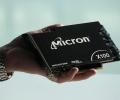
Micron Technology, a global leader in memory and storage, is considering supplying Made-in-India chips from its Gujarat plant to one of its key global clients, Apple, whose vendors assemble iPhones in the country. Micron is setting up an assembly test marking and packaging (ATMP) plant in Sanand, Gujarat. Currently, Apple vendors import chips for manufacturing iPhones. Sources in the know say the aim is to use part of the production to supply to Micron's clients in India directly.
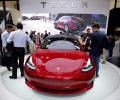
Tesla's plan to manufacture its affordable electric car priced at $25,000 in India and Mexico could materialise sometime in 2025 or thereafter, with Elon Musk declaring that these models would be produced at its existing factories to utilise their full capacity before investing in new manufacturing lines. The company operates factories in Texas and Fremont in the US, Berlin in Germany, and Shanghai in China. By the end of the calendar year 2023, Tesla was manufacturing 1.8 million vehicles annually.

'Elections and audience interest in specific movies are often independent factors.'

Annamalai has faced criticism for the breakup between the AIADMK and the BJP, but BJP leaders say 'he attracts youth, who needs change'.

India is far behind global competitors such as Vietnam, Taiwan, and Mexico in increasing electronics exports to the US by making the most of Washington's tariff action against China. In 2018, the US imposed a 25 per cent punitive duty on a range of Chinese electronics items. The trade duties led to a sharp fall in Chinese electronics exports to the US from $207 billion in 2018 to $140.2 billion in 2019, down 32 per cent, according to Indian Cellular and Electronics Association (ICEA) data, which has been analysed by ITC Trade Map.

For the smart phone industry, it has been a lacklustre quarter of CY2024, with sales falling by 3-4 per cent over the same period last year, according to Counterpoint Research projections. However, with the launch of many new models in Q1 of CY24, overall shipments grew year-on-year by 10-12 per cent. In CY23 shipments remained flat, ending the year with 152 million units.
'Gujarat is the frontrunner at present.'
'However, Tamil Nadu's robust automobile ecosystem and Telangana's aggressive incentives make them strong contenders.'

'In life insurance, it is about creating distribution capacity and solutions for customers. We are constantly working on that.'

Led by Ola Electric, which registered an industry record of 53,186 vehicles in March, electric two-wheeler (e2W) penetration hit a record at 8.91 per cent - the highest ever for a month (based on Vahan data).

Despite all the noise around India's chance to leverage the China-plus one strategy, India's share of global foreign direct investment (FDI) inflows fell from 3.5 per cent in the first nine months of 2022 to 2.19 per cent in the same period in 2023, according to OECD data. The sharp drop of 54 per cent is much steeper than the overall global FDI inflow decline of 26 per cent in the first nine months. FDI inflows to China have fallen dramatically from a share of 12.5 per cent in the first nine months of 2022 to only 1.7 per cent in the same period in 2023.

If Tesla comes in, India's position as a manufacturing hub will rise many notches, as it will become only the second country, after China, to have both Apple as well as Tesla.

A Rs 7,056 crore outer harbour project by VO Chidambaranar (VOC) Port in Tuticorin is garnering interest from domestic and global majors in the sector, such as Adani Ports and Special Economic Zone, Singapore's PSA International, Dutch major Van Oord, JM Baxi, and JSW, among others, according to sources close to the development. The project aims to capitalise on the newfound investor interest in the region, spurred by mega investments such as the Rs 16,000 crore electric vehicle manufacturing unit by Vietnamese major VinFast, the Indian Space Research Organisation's second spaceport in Tamil Nadu's Kulasekarapattinam, and Singapore's Sembcorp's Rs 36,238 crore investment in renewable energy.

'During the scorching summer months of election season, largescale outdoor gatherings create a prime opportunity for increased consumption in the packaged drinking water category.'

After a tentative start, quick commerce (q-commerce) is ablaze, with Blinkit and Zepto slugging it out in a market distinct from other competitors. The latest entrant is Flipkart, which is ramping up its infrastructure in around 12 cities where it will launch the service in the next six to eight weeks, taking on existing players such as Blinkit, Zepto, Instamart, and BigBasket, among others. According to data analysed from Sensor Tower by BofA Global Research, the daily active user (DAU) base of Blinkit has grown by 58 per cent between February 2023 and February 2024.
 © 2026 Rediff.com - Advertise with us - Disclaimer - Privacy Policy - Sitemap - Feedback - About us - Terms of use - Grievances